Three methods of search: landscape, treasure and a link to it.
You’ll find the Part I of the article here.
In the second part, I will present three methods that I use to go beyond the established perspective to find the appropriate one for me. I also present short cases to apply them in software projects, database structure and visual worlds’ extension.
1st method: Larger reality or a relativity start point
Here comes a first search method. I may call it a method of a larger reality or a relativity start point. Its goal is to change a point of view: to look at the famous painting as at one among the others. I try to take off anchors like public opinion, personal attachment and classifications of any kind. By doing this, I turn off a focus on this painting. Without this strong focus, I may see other paths, other paintings, which may be not famous but may suit me better in my accurate situation.
It’s a complicated exercise as it asks to turn off familiar references and dive into the ocean of directions and paths. I make an analogy with a lighthouse in an ocean. Once there is no lighthouse or it does not suit anymore the navigation, it may look that there is nothing outside and no indications.
At the beginning ofThe Waves Extinguish the Wind (1985),a novel by Boris and Arkady Strugatsky, there is a story about people dealing with unknown and their reactions. Some of them didn’t really experience a fear of unknown, rather a discovery. I think that this practice of observing the accurate situation without previous mind patterns exists in many spiritual, religious and esoteric studies. First, it seems that there is no lighthouse in the ocean and no understanding or support. Then new details and forms appear around. The lighthouse did not disappear. It came inside.
I know that it sounds esoteric, it actually may be. But I think that it’s also a practice of understanding an accurate situation and an appropriate choice. The goal of this practice is to fix on a concrete and personal goal in a concrete case. It’s not about the best or the famous decision or painting, but a painting, which suits most in a particular case.
A famous painting leaves its shadow of unapproachable, perfect, a gold standard look. It joins other paintings as it is, as a painting among the other paintings. Without pre-ordered opinions and associations, illusions and clichés.
Application software modules to increase analogy search:
Option to disable reference’s position in a search engine
Option to disable references by date, history period, author authority and theory authority (number of citation and publications).
Option to disable simple common tags and keywords for the searchable content or attribute them a secondary supportive role.
Option to include and extend symbolic references in search algorithms
Search for ‘’gothic’’ may give as following: history period objects, mood analogies from other periods, dark, mystic texts, images; duotone or black-white, violet-silver color palette and so on to extend common analogies and create new ones.
Option to manage orbits of analogies (See AI and polymathy article for more details)
I take here an astronomico-astrological analogy of planetary orbits as crossroads of analogies. Let’s take a conjunction of two analogies (‘’gothic fiction’’ and ‘’building’’) to find their mutual influence. And then let’s extend not similar but alternative, supplementary, compatible associations and their interaction. With astronomico-astrological analogy in mind, Saturn conjunct Pluto vs Saturn conjunct Lune will have different time period, different nature, different allegories et ct.
Option to turn on focus on an appropriate goal and situation
Include more personal descriptions instead of suggested (personal vs common use)
Include more symbolic metaphors and analogies instead of similar images and words to the search subject.
Search with the similar images or common descriptive words risk producing the same perspective. This may lock a search in the same perception without going beyond the similar authors and information’s. I think that the AI tools today and neural networks in particular today may increase the data interaction with more symbolic metaphors and more personalized descriptions.
2nd method: Treasure in other dimensions
A second method focuses on common, ordinary or controversy applied to the current search goal or an appropriate situation. Something common or ordinary may also be actual for one and dogmatic for another.
I propose to operate with dimensions of searchable information and apply them to a concrete goal of search.
I suggest switching to questions. For whom this information is considered as common? Until when this data is considered as ordinary? From what point of view is this search path common? For which goal is this concept ordinary, dogmatic or actual?
This method highlights a circulation of information as well as ideological, fashion, time goals and interests.
I may suggest considering a re-cycle of information, which means to me a personal cycle that information follows in time.
Even if an idea is not popular, fashionable or no longer considered modern, it doesn’t mean that this idea or data is no longer important or shouldn’t be searchable. It just not suit for some current time practices, interests and goals. According to this, I think that a rigid indexation, an order or cancelling may stop natural circulation of information.
The same information may be common, ordinary, dogmatic, old fashion, controversy, depending on use, cases and objectives.
This method focuses on a treasure opportunity, which information provides. But this opportunity applies to an appropriate situation, a concrete goal, a particular point of view and a moment in time. It’s a method to see ordinary, common and available information through the prism of appropriate conditions. I suggest to turn on a focus from a search object to the accurate situation. In this case, information stays relative until it faces an appropriate situation, where it becomes interesting, disgusting, useful, ugly, unappreciable or fluid according to the concrete goal.
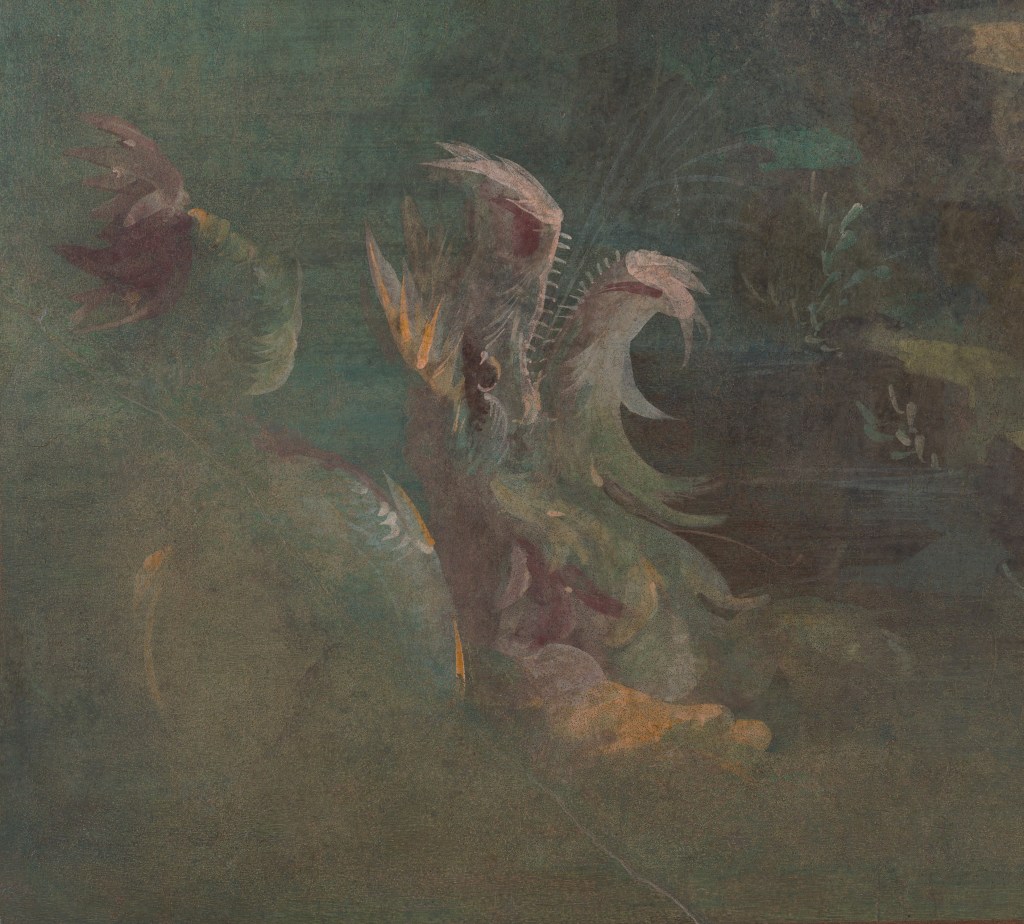
I wish to make a metaphor with myths of treasure, caverns and dragons. In these stories, caverns hide treasure and dragons protect it. I suggest that caverns are an analogy to a way we look at something. The caverns in stories are not easy to find at first, their outlines often become visible, when a hero changes his method of search. This changing point often suggests magic implication to see caverns. Like caverns, changing a dimension, look differently, data or information offers new opportunities, and highlights the relative side of information. I suggest that dragons are a metaphor for illusions, clichés and dogmas. They hide and hold new dimensions of information until the point of view liberates of them to go beyond and unlock the relative side of data.
Application software modules to increase analogy search:
Option to turn on/off a stateware component
Stateware as an impression or a state of search: intention, expectation, application description at a particular moment of time to integrate in keywords search. I suggest to focus on a fixed and concrete situation or a goal of search instead of the fixed search results. In this case, the search is applied to a state of intention and perception of those who search and may provide more relative and synchronistic information.The more fluid and unfixed results provide more flexible and multidimensional paths, which may be nonlinear. The fixed search may pre-order a direction, which would be difficult to go beyond and find new analogies and associations.
Option to disable a classification (stars/scores/order)
As limited and relative without an application to a concrete situation.
Option to include more description, more perception and explanation.
Or an option to enable a classification and indexation applied to a concrete situation as a one particular form in time of information/person/search.
Option to increase a niche and decentralization search
Include a niche search option to apply specific and personalized keywords and analogies. In today search there is a tendency to apply the most famous, marketing references and words. This often leads to put keywords that don’t describe the subject or to increase the score of the most searchable words at the point, where they lose their utility.
Like in a story about a boy and wolves. A boy called people to notify about wolves, which weren’t there. People came and saw no wolves. A boy called people again saying there were wolves. They came again and saw no wolves. The third time a boy called people, and people didn’t come. The wolves were there this time but people stopped following calls.
I think that the same happens to the keywords used for marketing or emotional attraction. They stop meaning something, as they are not suit anymore the core function – a description and meaning of a particular thing.
Option to index different dimensions and states of the same keyword or object of search. Decentralize even the same keyword and meaning search by adding different intensions, goals, point of view to increase the relevant search for a relevant and actual point of view.
3rd method. Keypath
I have already explored a keypath as an extension of a keyword for searching, linking and organizing information. You’ll find its first presentation in the Synth Issue #1 chapter Searching for a name: from keyword to keypath concept as a part of the article The Rename: from monks and orders to users. Otherwise, you’ll find this chapter of the article in the post Keypath.Overview.
Keypath is an organic image or a created pattern of an idea or a search. Like a living organism, it’s not a number of functions and characteristics but a whole working process.
In this case, a keypath is not a number of words, but an interaction of their intention and context; the way in which someone creates analogies and links between them.
We often search for what we already know.
A keypath offers a pattern, a process of someone’s logic and intention. In this case, it offers a perspective of crossing search analogies as well as new associations and contexts.
Another advantage is a presence of metaphors, symbolic description and their place, influence and role in a search. When we search, we are not always capable to find exact words to describe what we search. And sometimes the context or a perception form different descriptions for the similar ideas and different contexts for the similar things.
A keypath is a way to get access and go beyond the known and established search patterns. To catch the most possible accurate and synchronistic analogy, yet unknown. As an example, it may be a little known painting (or unknown for you at that time), but which may have a personal technique and emotional influence at your drawing at that moment. In this case, this particular painting will be more productive that a generic one or already studied painting that doesn’t matches for you at this particular moment and for your particular current goal.
A keypath is also a more complex system to face marketing context search. Actually the ‘’context search’’ invasion with generated number keywords often doesn’t allow to find the accurate goal. And the keywords themselves lose their context and search functionality.
A key path also offers more complex interaction search. This may increases a context search and extract some actual and accurate contexts from the whole ideas. I make an analogy with an observation of nature phenomenon like rain or a behavior of a wolf in a forest.
Observing a behavior and a process may give much more context and interaction functions that a fixed image. In this case, a keypath is a process of different components, contexts and influences of an idea, a post, a category or a term; and a keyword is more a fixed image.
A keypath also increases a search for a part of information, which is difficult to find now. I mean by this a particular commentary from a blogpost or a discussion feed. I and many other people find this kind of information even more important and accurate in some cases. However, this is practically unsearchable for now, especially for the context search. Still, there are many potentially useful and searchable comments on social media like Youtube or Reddit without mentioning a number of blogs comments.
Application software modules to increase analogy search:
Option to enable a keypath as an organism of forms and functions
For example: a tag from the 21st century, a diary note from the beginning 20th century, a blog paragraph from the 1990s
Option to manage organic’zation
Create and organize an organic structure of data, its context role and its accurate function in the keypath.
This presentation may be a way to organize a personality toolbox or an information structure of any kind from the data and its interaction with a particular goal (extension to the personal blog/educational/industrial/cultural product). You’ll find more about a personality toolbox in The Synth Issue #1 article AI and Polymathy.
Option to create and update dynamic patterns and ornaments of a keypath
This option offers dynamic changes in a way someone creates and manages contexts for his ideas. It’s a way to update and modify links, analogies and contexts of the existing path. It’s also a way to storage keypath versions as patterns of meaning and perception to re-use. I make an analogy with a tourist path into a forest. It’s not a result or a destination that may be interesting, but a process, a way that someone does it. How did this person walk, in which rhythm and manner? What did he eat and where did he sleep at night? What were his observations and discoveries? All this may be an accurate for someone else even more that a destination itself.
 Hermenaria