Hermenaria is currently participating in ZOHO Creator Hackathon 2024 to develop a software application called Сrow Eye for niche collections and databases.
____________________________________
Update on 3 July 2024
Crow Eye is in beta version now
____________________________________
Hermenaria project has currently submitted the software application Сrow Eye for the ZOHO Creator Hackathon 2024 competition on 30 June 2024.
The application is in its beta version and I will continue to develop its features as well as preparation for the official launch.
____________________________________
Participation in beta version tests
If you wish to participate in beta version tests or submit your requests for additional features, please contact Hermenaria on niche@hermenaria.com or on Reddit/Patreon/Pinterest social media pages of Hermenaria project.
____________________________________
Software application features, methods and case study
Want a specific example of how it works? Ok, click to see directly the case study here.
Still, emptiness state’s involvement in this application is worth to know by reading the long text below
Core goal: increasing interaction within existing collections and optimizing context search
The core goal of application is to search and use of collections objects by linking them to symbolic interpretations and personalized analogies.
These associations create a context personal reference in time a space on a particular symbol and collection object. This increases the use of collections and creates more accurate communication and search between users and the context they want to explore.
____________________________________
Śūnyatā or emptiness and naming: thinking with images and states rather then with social theories
I refer to the state of Śūnyatā or emptiness as I understand it. There are infinite states of perception and we name things around us according to our current interpretation. This is why an interpretation or intention as inportant as a word or symbol themselves.
I also think that we search, imagine and communicate more with images and states rather then with social theories, mental concepts and cultural temporary fashion. This is the reason we often search not what we imagine but using the society themporary concepts, rules and illusions which not describe our goals, percpetion and intention.
____________________________________
Application method resolving a problem of search by id (author, title, date)
This method resolves the problem of naming. We usually can’t search for an author, a title of a text, image or an object if we don’t know them (their id or indexation). This makes many available for use and consultation texts, images and objects unsearcheable as long as you are not aware of their metadata.
The main problem causing by this is the lack of references or links, which lead to these available materials. With time, even if these materials exist in a collection, library or museum, they may stay blocked in their initial classification. Unless you discover the id or the title, you cannot possibly find its existance. That’s how many materials, knowledge and information exist, hidden by personal, strict or accurate in time but useless in a current situation classifications.
____________________________________
Case study of how it works with a specific collection object
Let’s take an example of Remedios Varo artwork Creation of the Birds (Creacion de las aves), 1957
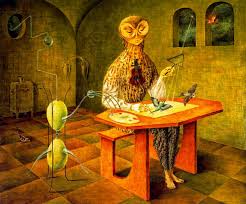
Source: Internet,
Hermenaria project does not own any rights of this image
I take this example as I recently discovered this artist in an art bookshop in Barcelona. I didn’t search for her and might never knew, but I took attention of the attractive book cover, with no understanding of the book title as I don’t speak spanish.
This is an example how a reference, a style, a symbol of an image worked on me rather than an id of the book (by which I mean the title, name or art category as surrealism) .
Actual way to search for this artwork
For now, you may find the references to this artwork if you know its id (the title/author), or by keyword as creation or birds. You may also find her by searching for surrealist movement but she wasn’t considered as a part of it for long time and any concept or art theory is based on critics of its own time.
The main problems are:
1) These words and even their combination are general and may give multiple references. You risk to find the reference to this artwork on the 100th page of the search but you will probably not go so far.
2) There are symbols, states, phenomena and objects on this artwork, which you may want to find but do not have any indications that they exist and make part of this particular painting.
Example of states, images, phenomena:
Alchemy; Renaissance; owl as a bird; owl as a messager between worlds; Egypt gods (as the creature on the artwork has a head of a bird and a body of a human); soul; spirit; maya/matrix; light; magic; music; rhythm of life and enigma among others.
What other metadata of a collection object may be presented and used as an analogy/symbol for the search :
There are also many multiple techniques, materials, textures, patterns and color duotons by which you may search and find this particular work. The advantage of including this kind of metadata is its symbolic use. You have more chances to find this work by searching for the gold color Renaissance making technique rather then by the title, which you never heard.
Personal associations as paths to collections objects:
Association example:
Enigma music group – Remedios Varo Creation of the birds artwork
There are analogies and associations, which may links to this painting even if you never heard about it. Let’s imagine, you like listening music group Enigma and musician Loreena Mckennitt. There is no a causal, direct link between them and a painting but you may experience the analogies between the music style, texts and essence of these music artists and Remedios Varo artwork.
In case of this personal analogy between music and artwork, this artwork has received a trail, a path for those who like or know Enigma or Loreena Mckennitt works.
One symbol and infinite interpretations
I propose to use a symbol with its personal interpretation because the interpretation gives more information about a context of the search, its intention and focus.
For example, Owl symbol as:
Owl – as a bird
Owl – as a forest spirit
Owl – as shamanism
Owl as Twin Peaks world
Owl as time
______________________________________
CrowEye application structure and use:
CrowEye application is designed for the three types of users:
Intranet database for museum, libraries and other organizations managing collections of objects, texts and visuals
As an Intranet database for the employees or groups managing the collections’ internal database. The users add and modify data about symbols, their interpretations and analogies themselves.
Portal with a personal account to sign in and a forum for external users as a part of the collections’ official website
As a portal to sign in with a personal user account, (upcoming) forum and knowledge base for symbols collections. This portal option is designed to be a part of the collections’ official website, where any person may create an account and add their personal symbols, interpretations and analogies, related to the collections.
This option gives external users to expand the collections’ use by linking them and creating new analogies. This is also an option to create a community and satisfy specific needs of collections’ search.
An open browser page for the symbolic search in the collections’ internal database and external users portal
As a browser page with an access for every person without a personal account. This is a search page, where any person can search for collections’ objects, symbols, interpretations and analogies provided by internal database and extern users database.
This page offers a search by symbols and references, which link to the existing collections even if users don’t know the id of the objects (title, author, date). The core goal of this symbolic browser page is to increase the use and visibility of collections. Users search for the analogies and symbols as a start point to find the related to them collections’ objects.
 Hermenaria
You must be logged in to post a comment.